
Where Should Bottles Go? AeroCoach’s 2026 and 2020 Tests
Modern road-bike tunnel data first; then real TT-bike velodrome results
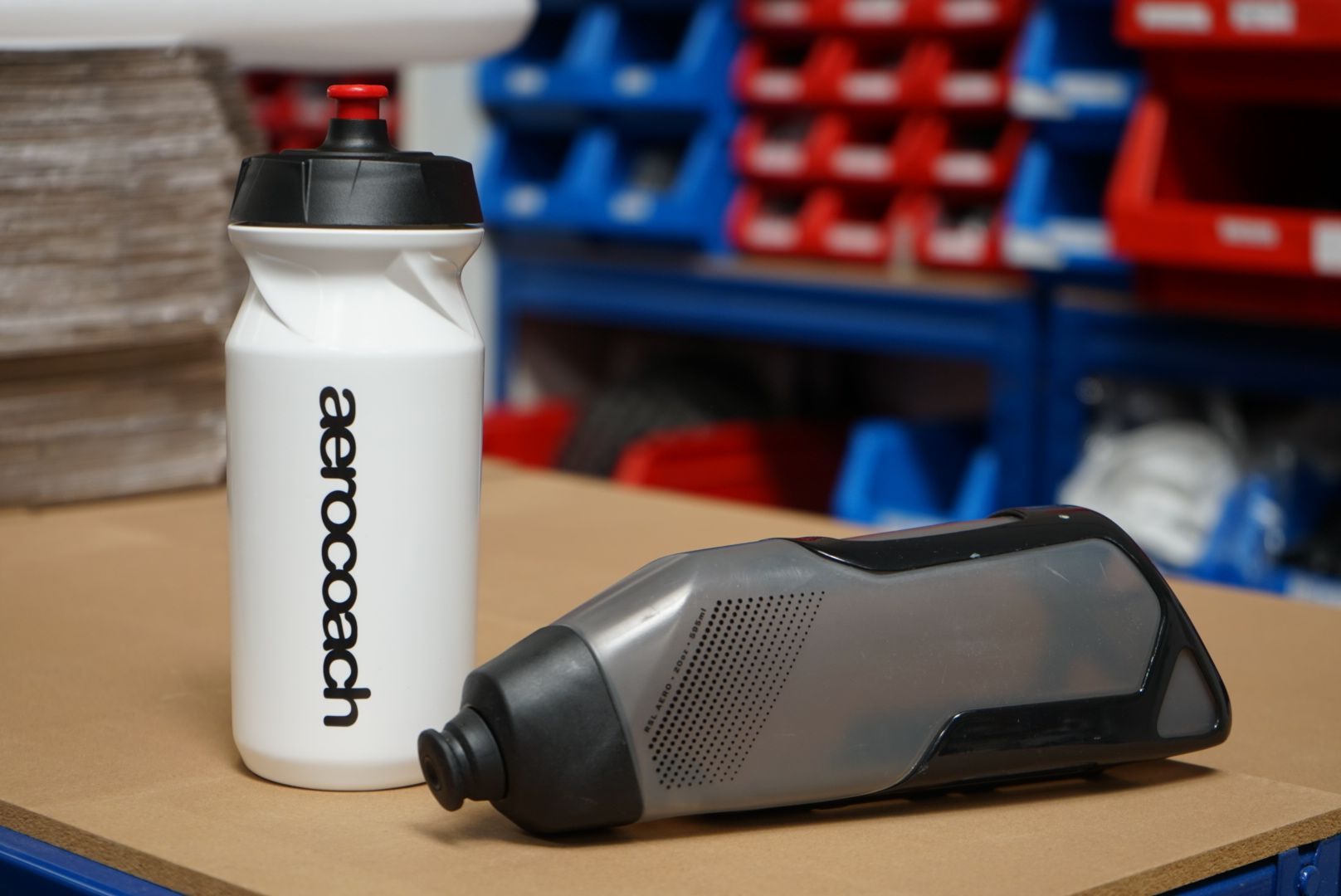
Round and aero bottles in the 2026 test. Source: AeroCoach — Road bike aero bottle testing (2026).
Two AeroCoach studies show how bottle drag depends on rider, frame, shape and location. The 2026 road-bike and 2020 TT-bike figures need distinct contexts.
Why can one bottle be nearly neutral on one bike while a two-bottle setup is substantially slower? Placement, shape and frame geometry matter more than a simple bottle count. AeroCoach published tests on an aero road bike in 2026 and a TT bike in 2020. We start with the newer wind-tunnel and velodrome results, then examine the earlier triathlon/TT velodrome test. They are different riders and bikes, not a direct matched comparison.
All numbers and original images come from AeroCoach, not RSTRI testing. Original labels, values and logos are preserved, and each image carries its own source credit. The two studies:
https://aero-coach.co.uk/road-bike-aero-bottle-testing ↗
https://www.aero-coach.co.uk/water-bottle-testing ↗
2026: Modern road-bike tunnel and velodrome test
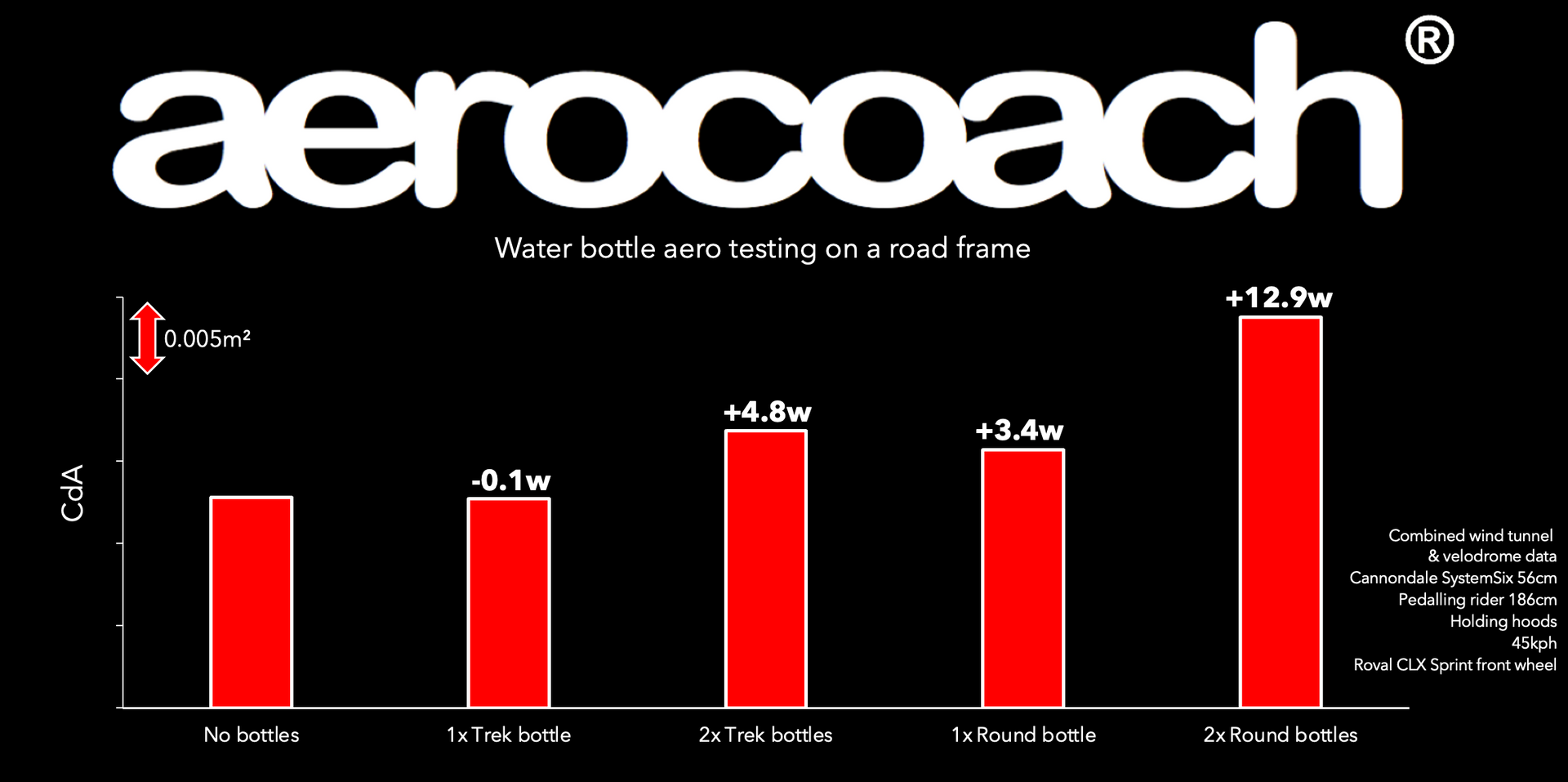
Xavier rode a size 56 Cannondale SystemSix. AeroCoach gathered data across several yaw angles in a wind tunnel and at a velodrome, comparing a 500 ml Trek RSL Aero bottle with a conventional 650 ml round bottle on the downtube, seat tube or both. Wattage differences below are at 45 km/h. CdA combines drag coefficient and frontal area and is often used to compare system drag.
This is one rider on one aero road bike, with a particular wheel and tyre setup, not a universal promise for TT bikes. A crucial detail: for single-bottle tests the downtube bottle sat as low as possible; in the two-bottle tests it sat higher.
Four measured configurations
Against no bottle, or the nearly equivalent single-aero-bottle reference, AeroCoach reported at 45 km/h:
- One Trek RSL Aero low on the downtube: about 0.1 W difference, within measurement error.
- One 650 ml round bottle low on the downtube: about +3.4 W.
- Two Trek RSL Aero bottles on downtube and seat tube: about +4.8 W.
- Two round bottles on downtube and seat tube: about +12.9 W, roughly 9.5 W above a single round bottle.
AeroCoach notes that at a slower 35 km/h, the wattage differences would be about half the 45 km/h figures. There is no fixed “cost per bottle” that applies to every rider.
Why did the aero shape suit this frame?
The SystemSix downtube was about 48 mm wide. The Trek RSL Aero measured about 50 mm at the cap join and 61.5 mm at its widest point. The round bottle was 74 mm across and wider than the downtube along its length. AeroCoach interpreted the longer, narrower aero bottle as a closer match to this frame. Bottle shape cannot be evaluated separately from the frame section behind it.

The “second-bottle penalty” is not isolated
Two round bottles were about 9.5 W slower than one round bottle, and the two aero bottles were also clearly slower than one. That makes the complete two-bottle configuration worth measuring. But these data do not isolate the pure effect of “the second bottle”: the downtube bottle was higher in the two-bottle runs, and the bottles can alter each other's airflow. Count, interaction and mounting height changed together.
A better question is whether the extra carrying capacity is worth the drag in the complete setup you actually ride. A short event may not need two bottles; a long one still needs reliable fueling. Do not simply add isolated wattages to predict a final race setup.
2020: Triathlon/TT-bike velodrome test
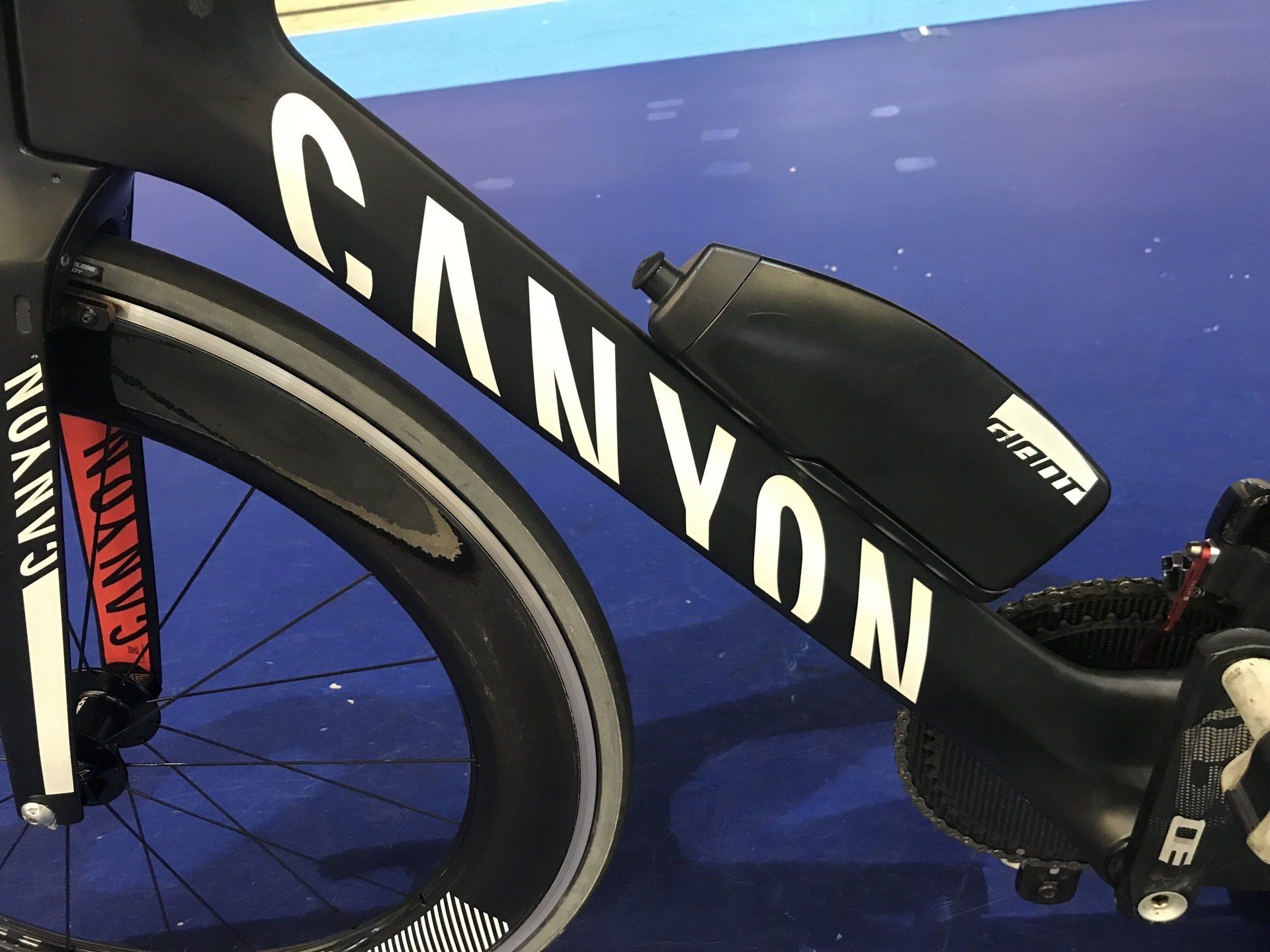
Jessica rode a Canyon Speedmax CF SLX TT bike while AeroCoach used the Garmin Track Aero System at a velodrome to compare hydration setups against no bottle. The wattage differences below belong to that rider, bike and position. CdA combines drag coefficient and frontal area; under comparable conditions, lower generally means less aerodynamic drag. BTA means between the arms; TT means time trial.
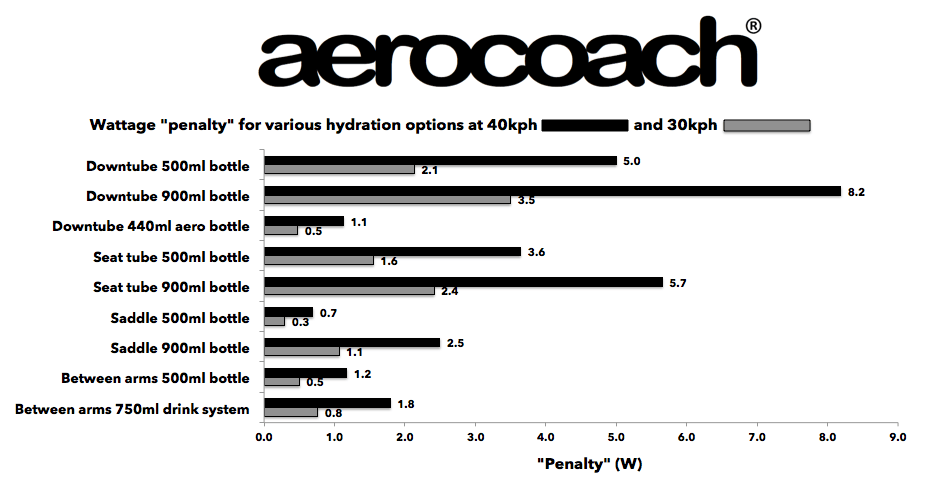
A 500 ml round bottle in four locations
Against the no-bottle baseline, AeroCoach reported:
- Downtube: +5.0 W at 40 km/h and +2.1 W at 30 km/h.
- Seat tube: +3.6 W at 40 km/h and +1.6 W at 30 km/h.
- BTA: +1.2 W at 40 km/h and +0.5 W at 30 km/h.
- Behind the saddle: +0.7 W at 40 km/h and +0.3 W at 30 km/h.
For an illustrative Ironman bike leg of 5 h 30 min at about 32.7 km/h, AeroCoach estimated roughly 2 min 05 s for the downtube, 1 min 30 s for the seat tube and 20 s for the rear bottle. These are scenario estimates, not promised race times. AeroCoach interpreted the downtube bottle as meeting relatively consistent airflow, while the rear bottle sat in air disturbed by the rider.


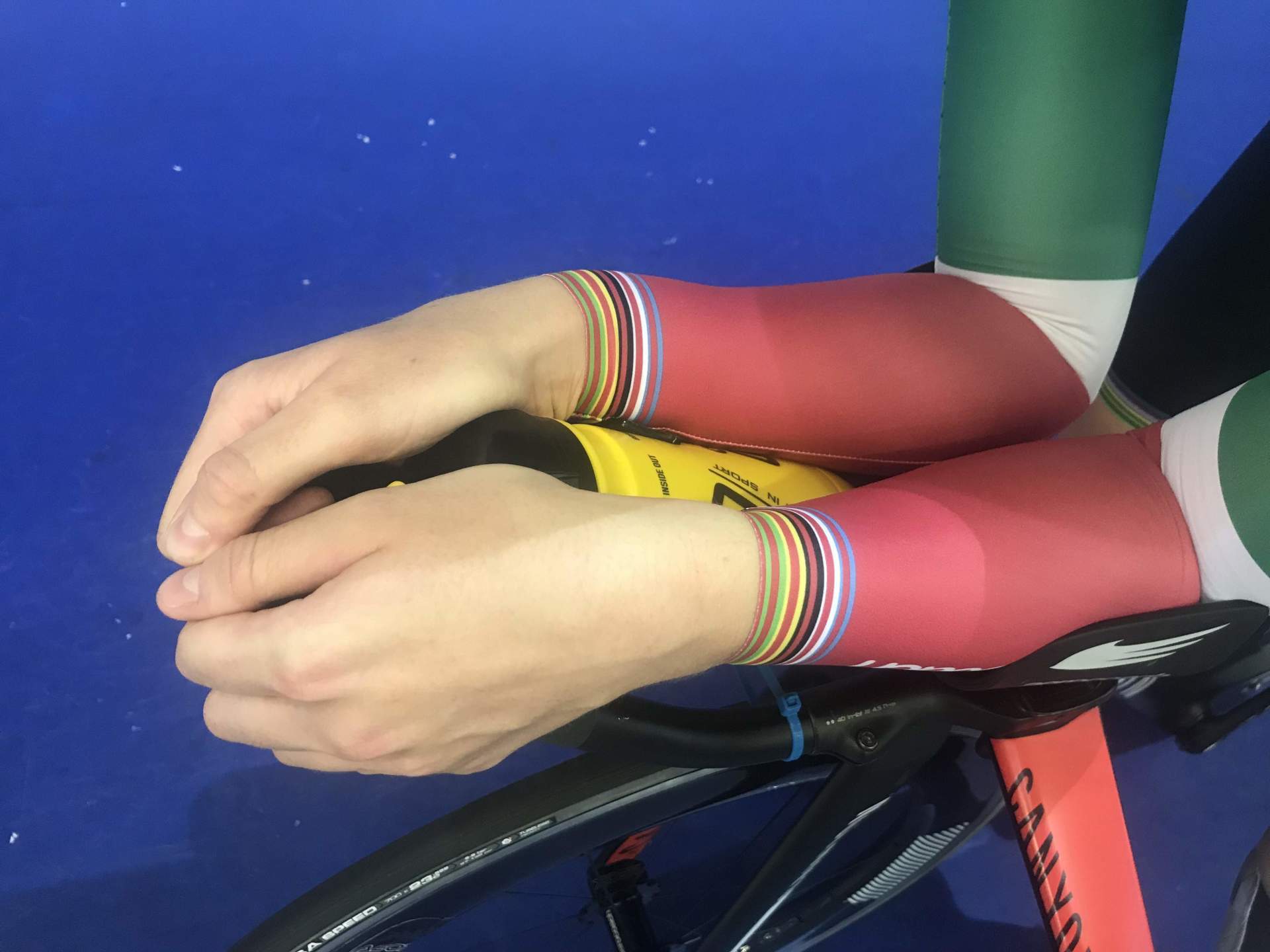
The +1.2 W BTA result does not make that location useless. A bottle within sight and reach may encourage Jessica to drink. AeroCoach also notes BTA tends to work better when the forearms are close together. Aerodynamics and fueling usability have to be considered together.
One large bottle or two smaller ones?
A 900 ml round bottle cost +8.2 W at 40 km/h on the downtube and +2.5 W behind the saddle. It was too large to fit between Jessica's arms. AeroCoach added two separately measured penalties, 500 ml BTA (+1.2 W) and 500 ml rear (+0.7 W), for a practical comparison: a projected +1.9 W for 1000 ml versus +2.5 W for the 900 ml rear bottle.

That +1.9 W is a sum of separate runs, not a fresh measurement with both bottles mounted together. The front bottle could change the air that reaches the rear one, so isolated wattages should not generally be added mechanically. It also shows why “fewer bottles must be faster” is not a safe default.
An aero bottle changes the downtube story
A 440 ml Giant AeroVault on Jessica's downtube cost +1.1 W at 40 km/h and +0.5 W at 30 km/h. The conventional 500 ml round bottle at that location cost +5.0 W and +2.1 W. AeroVault was designed for the Giant Trinity; AeroCoach notes that the penalty can be smaller, sometimes effectively zero, on that platform. Shape, mounting position and frame act together; “downtube bottles are slow” is too broad.
Check exposed straw length
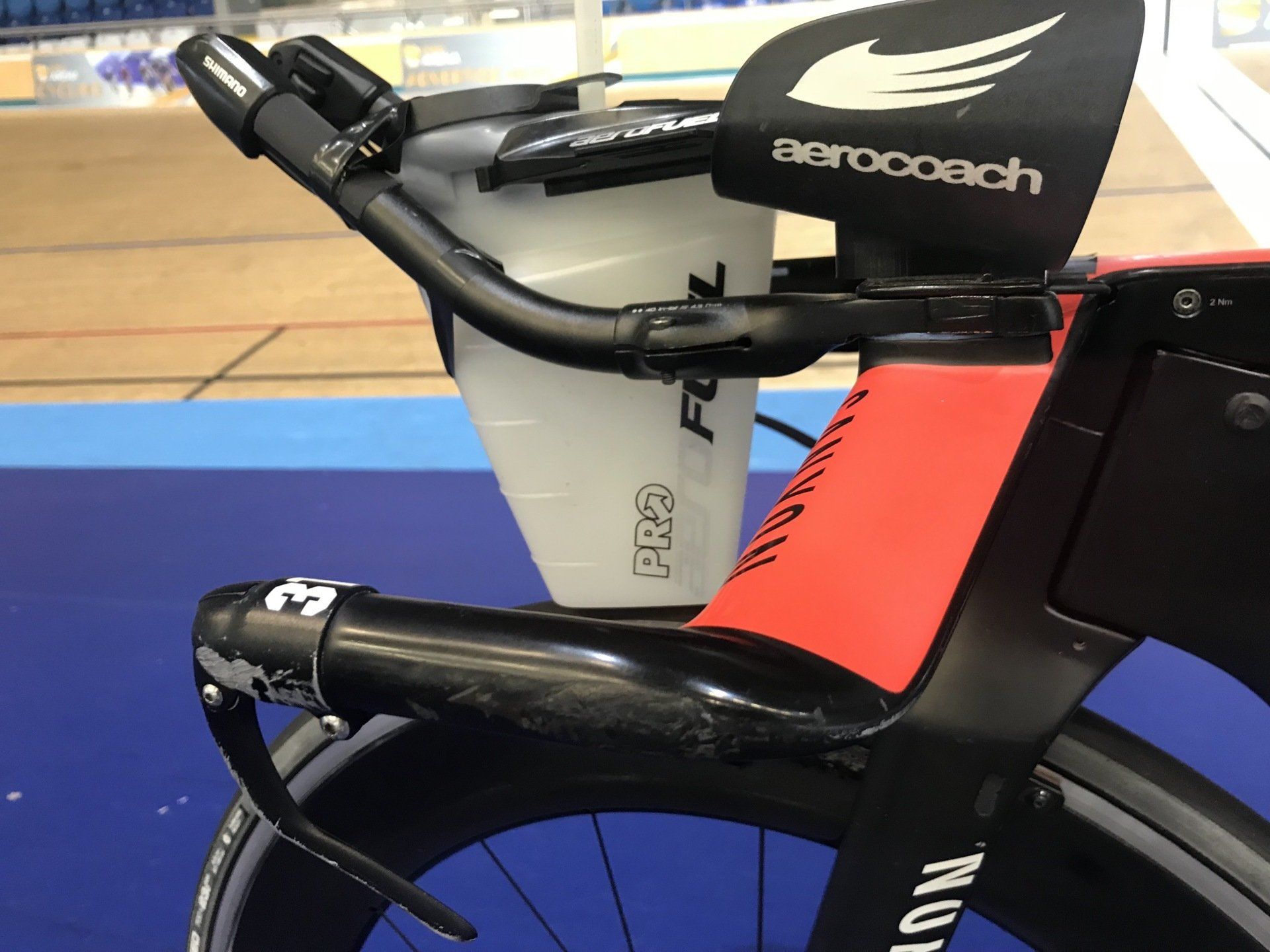
Jessica's 750 ml Pro AeroFuel BTA drink system cost +1.8 W at 40 km/h and +0.8 W at 30 km/h versus no bottle. Separately, AeroCoach had found in previous riders that excessive straw exposed to the wind could cost up to 3.5 W at 40 km/h. That figure was not a straw-only measurement from Jessica's run. Removing unnecessary exposure while keeping the system easy to drink from is a practical priority.
How should we read the two tests together?
The 2026 data use a Cannondale SystemSix at 45 km/h with wind-tunnel and velodrome testing. The 2020 data use Jessica's Canyon Speedmax at 40 and 30 km/h on a velodrome. Their wattages cannot be compared directly, nor do they establish a universal fastest location on a triathlon bike.
Together they suggest a useful order: first ensure enough fluid and fuel, a secure mount and easy access. Preserve a position you can sustain. Then compare the actual bottle shape against the frame and airflow around your body. Finally test the complete race setup, including all bottles, straws and mounts. The 2026 two-bottle difference cannot be assigned solely to bottle number because mounting height also changed; the 2020 projected +1.9 W for two smaller bottles is a sum of separate runs, not a full two-bottle retest. Neither number is a universal product claim.
References
AeroCoach, “Road bike aero bottle testing” (2026), Cannondale SystemSix tunnel and velodrome data:
https://aero-coach.co.uk/road-bike-aero-bottle-testing ↗
AeroCoach, “Water bottle aero testing” (2020), Jessica Rhodes-Jones TT-bike velodrome data: