

Why Can a Bottle Sometimes Reduce Drag on a Triathlon Bike?
What public CFD tests can—and cannot—tell us about BTA and rear bottles
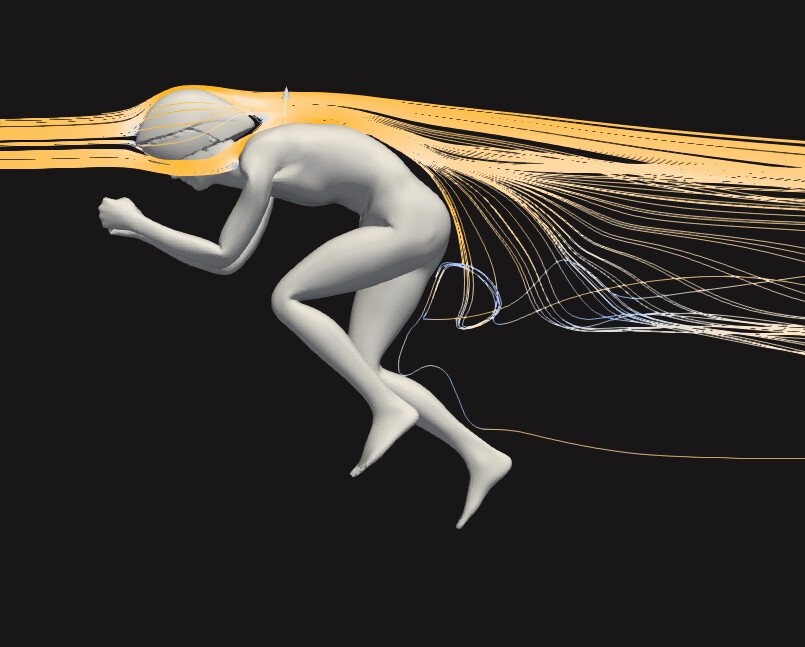
Rider and helmet model used in the original discussion. Source: ijaero / Slowtwitch — Bottle Positions CFD Tested: Bottled Speed (2025).
Adding a bottle does not always add drag. Its effect depends on the rider's airflow, position, and the limits of the test.
This article interprets bottle-position tests published by Slowtwitch user ijaero in 2025, including later posture comparisons and comments from wind-tunnel testers. The original CFD images are reproduced with permission, with their labels and values intact and a source credit on each image.
Source: ijaero / Slowtwitch — Bottle Positions CFD Tested: Bottled Speed (2025).
https://forum.slowtwitch.com/t/bottle-positions-cfd-tested-bottled-speed/1285072 ↗
What was actually tested?
CFD means computational fluid dynamics: a numerical way to study airflow. CdA combines drag coefficient and frontal area; under comparable conditions, a lower value usually means less aerodynamic drag. BTA means between the arms, while TT refers to a time-trial position.
To limit computation, the author modelled a rider, helmet and bottles, but no bike, saddle or bottle cages. The rider-only baseline was about 0.192 m² CdA. The often-cited 0.222 m² was the author's estimate for a complete system with a high-end triathlon or TT bike, not a measured full-bike result from these bottle runs. The simulations used 0° yaw, or head-on airflow. Sidewinds, different bikes and real mounting hardware may change the outcome.
A BTA bottle can improve the whole system
For the first, relatively upright long-course position, every BTA setup the author tested was faster than no bottle. A bottle sits within the airflow around the forearms, chest and head. Its own frontal area may be outweighed by a more favourable flow around the rider as a whole. The author cautioned that bottle orientation may depend on bottle shape, so facing a cap forward or backward is not a universal rule.

Change the posture and the answer changes
The author then lowered the arm pads by about 9 cm, with a flatter torso and lower head. In this more aggressive TT model, the tested BTA bottle was slower than no bottle. A wind-tunnel tester in the discussion described a professional athlete who went faster after removing the highest front bottle because it allowed a better head position. Bottle placement and rider posture cannot be separated.
A later contributor reported tests of one 750 ml front bottle at different angles. In that particular BTA setup, a vertical bottle beat the no-bottle baseline while some tilted arrangements did worse. This was a separate front-bottle comparison, not evidence that a vertical rear bottle is always faster.
Rear bottles depend on proximity to the rider
In the initial rear-bottle tests, placements close to the body and more nearly horizontal performed well. A low bottle against the lower back also produced a favourable result in that model. The author's streamlines suggest a possible mechanism: the bottle changes air that bends down along the lower back and alters the wake. That is a reason to test a position, not a guarantee for every rider.



With the flatter TT posture, the lower-back bottle changed from beneficial to slightly worse, although some conventional rear-carrier positions still helped. The original model omitted the saddle and carrier, so their shapes, the rider's position on the saddle and the gap to the bottle could all matter in practice.
Why individual gains do not add up
You cannot simply add the savings from a BTA-only run to those from a rear-bottle-only run. A front bottle changes the air reaching the torso and rear. The final race configuration must be tested as a combined system.
CFD is excellent for repeatable screening, but it can also test a bottle floating in space without a cage. It does not automatically account for reaching a bottle, losing it on rough roads or fatigue changing posture. One wind-tunnel tester described a component predicted faster by CFD that proved about 4 W slower in the tunnel. This is a caution about validation, not a general 4 W error rate.
A practical way to choose
First make sure bottles are accessible, secure and support your hydration and fueling plan. Keep your riding position consistent while comparing BTA height and fore-aft placement, then rear-bottle distance and angle. Watch for any change to head or elbow position. If possible, validate the complete setup in a wind tunnel, velodrome or carefully controlled outdoor comparison.
This is an educational interpretation of a public discussion, not a promised saving in watts or minutes. A bottle's aero effect belongs to the rider-and-equipment system and depends on the person, posture, mounting hardware and conditions.
Source
Primary source: ijaero, Slowtwitch Forum, “Bottle Positions CFD Tested: Bottled Speed” (2025), original post and replies #8, #11, #16, #37 and #104. The CFD figures here are reproduced from the original thread with their labels and values intact.
https://forum.slowtwitch.com/t/bottle-positions-cfd-tested-bottled-speed/1285072 ↗