

What Kona 2026 Pro Bike Positions Tell Us About Modern Triathlon Aerodynamics
What 14 race-side positions reveal about trends, coupled geometry and testing limits
Reported distribution across 14 positions: full range, middle 50% and median. Redrawn from Flapp Academy statistics.
A technical reading of 14 side-view pro positions: forearm tilt, elbow geometry, torso angle, and the limits of aerodynamic inference.
RSTRI Tech | Independent analysis. Based on measurements reported in Flapp Academy’s Kona 2026: What 14 Pro Bike Positions Actually Measure. This is not a translation or a product endorsement. Refer to the source for its photos, definitions and methods.
Raised forearms are no longer unusual
Flapp examined 14 side-view positions of professional athletes. Reported forearm tilt had a 25° median, a 21–26° middle 50% range, and a 10–31° full range. Seven positions exceeded 25°; only two were below 15°. A photographed forearm angle should not automatically be equated with a manufacturer’s extension-tilt specification.
- Trunk to horizontal: 20° median; 17–24° middle 50%; 12–32° full range.
- Shoulder angle: 85° median; 77–88° middle 50%; 71–97° full range.
- Elbow angle: 80° median; 76–89° middle 50%; 62–107° full range.
- Forearm tilt: 25° median; 21–26° middle 50%; 10–31° full range.

This describes a small sample; it does not establish an optimal 25° tilt. The sample is not random, and camera perspective, frame selection, landmark estimation and angle conventions introduce uncertainty. Without matched aerodynamic measurements, it cannot rank riders by CdA.
Forearm tilt and elbow flexion are coupled
The source reports a negative correlation between forearm tilt and elbow angle (r = −0.76): greater tilt tends to coincide with a more flexed elbow. Correlation is not proof that raising the hands causes elbow flexion. Pad position, extension reach, grip and shoulder posture may all move together.
The front end is a system of hands, elbows, shoulders, head and torso. A change that hides the head within the arm silhouette for one rider may force another to lift their chin or tense their shoulders.


A lower torso is not always the answer
The sample’s median trunk angle was 20°. Research models discussed in the source suggest that a lower trunk can reduce projected area, but an extreme posture can compromise sustainable power, breathing and hip clearance. The roughly 17° compromise mentioned in the source is model-specific, not a universal fit target.
For long-course triathlon, the relevant outcome is performance over time: drag, power production, ability to stay in position, comfort and the run that follows. The lowest CdA achieved briefly may not deliver the fastest race.
Separate body-position gains from cockpit gains
Three variables should be examined separately:
- Forearm pitch, which changes the relationship among hands, elbows, shoulders and head.
- Lateral elbow spacing, which changes frontal shape and flow between arms and torso.
- The cockpit’s own geometry, which can affect local drag and flow at different yaw angles.
The source cites a single-rider aerodynamic study reporting approximately 3.0%, 7.7% and 11.2% CdA changes across different combinations of hand elevation and elbow narrowing. These are conditional results, not a general claim that tilting extensions alone saves 11.2% CdA. Nor can the combined effects be cleanly assigned to individual changes.
An integrated cockpit may have aerodynamic properties of its own, but those are distinct from changes to the rider’s silhouette. Product comparisons should hold rider geometry as constant as possible; position comparisons should control equipment. At non-zero yaw, a frontal photograph cannot establish drag or demonstrate a beneficial “sail effect.”
A shoulder angle below 90° is not automatically an error
Five of the 14 positions had a shoulder angle below 80°, with a minimum of 71°. The traditional reference cited by the source uses roughly 90° between torso and upper arm, but does not define every smaller angle as a fault. Check instead whether the shoulders are shrugged, breathing is restricted, or the rider is holding the upper body up with continuous muscular tension rather than stable skeletal support.


All 14 positions
Ordered by forearm tilt from 10° to 31°. Green is inside Flapp’s reference range, amber is just outside or below it without a score penalty, and red is outside. These colours are a position rubric, not a CdA or speed ranking. The ring on Position 04 marks the manually corrected shoulder landmark.


Measurement boundary: photographs are not a wind-tunnel ranking
The source screened 15 race photographs and rejected one after the model selected a motorbike passenger instead of the rider. The remaining 14 were measured in 2D on the side nearest the camera. All were drive-side images; because the chainring can corrupt ankle tracking, the source deliberately omitted knee angles and saddle-height judgements. A 2–3 cm landmark miss can shift an angle by about 3°, and an athlete may appear more than once. These numbers describe the shape of a photographed field. They do not diagnose an individual or replace a professional fit, wind-tunnel work or repeatable field testing.
A practical testing approach
Record a repeatable baseline: saddle and crank configuration, pad stack and width, extension reach, forearm tilt, target power, and side/front photographs. Change one main variable at a time, then track comfort, sustainable duration and head posture at matched power. Where possible, validate CdA with a wind tunnel or a repeatable field protocol. Two side-view photographs alone cannot establish aerodynamic savings.
Takeaway: high-forearm positions are an important trend to investigate, not a universal prescription. Cockpit drag and body-position drag must be distinguished. The goal is a complete rider–bike system that remains fast, powerful and sustainable in real conditions.

Sources and further reading
Flapp Academy, Kona 2026: What 14 Pro Bike Positions Actually Measure:
https://getflapp.com/academy/kona-2026-pro-bike-positions ↗
Flapp Academy, Aero Position: Where Your Speed Actually Hides:
https://www.getflapp.com/academy/bike-aero-position ↗
Maddocks & Walker (2025), single-rider study of hand height and elbow width:
https://doi.org/10.1007/s12283-025-00495-7 ↗
Fintelman et al. (2014), torso-angle aerodynamic and power models:
https://pubmed.ncbi.nlm.nih.gov/24726654/ ↗
Current UCI regulations and technical documents:
RSTRI LAB
Continue Exploring
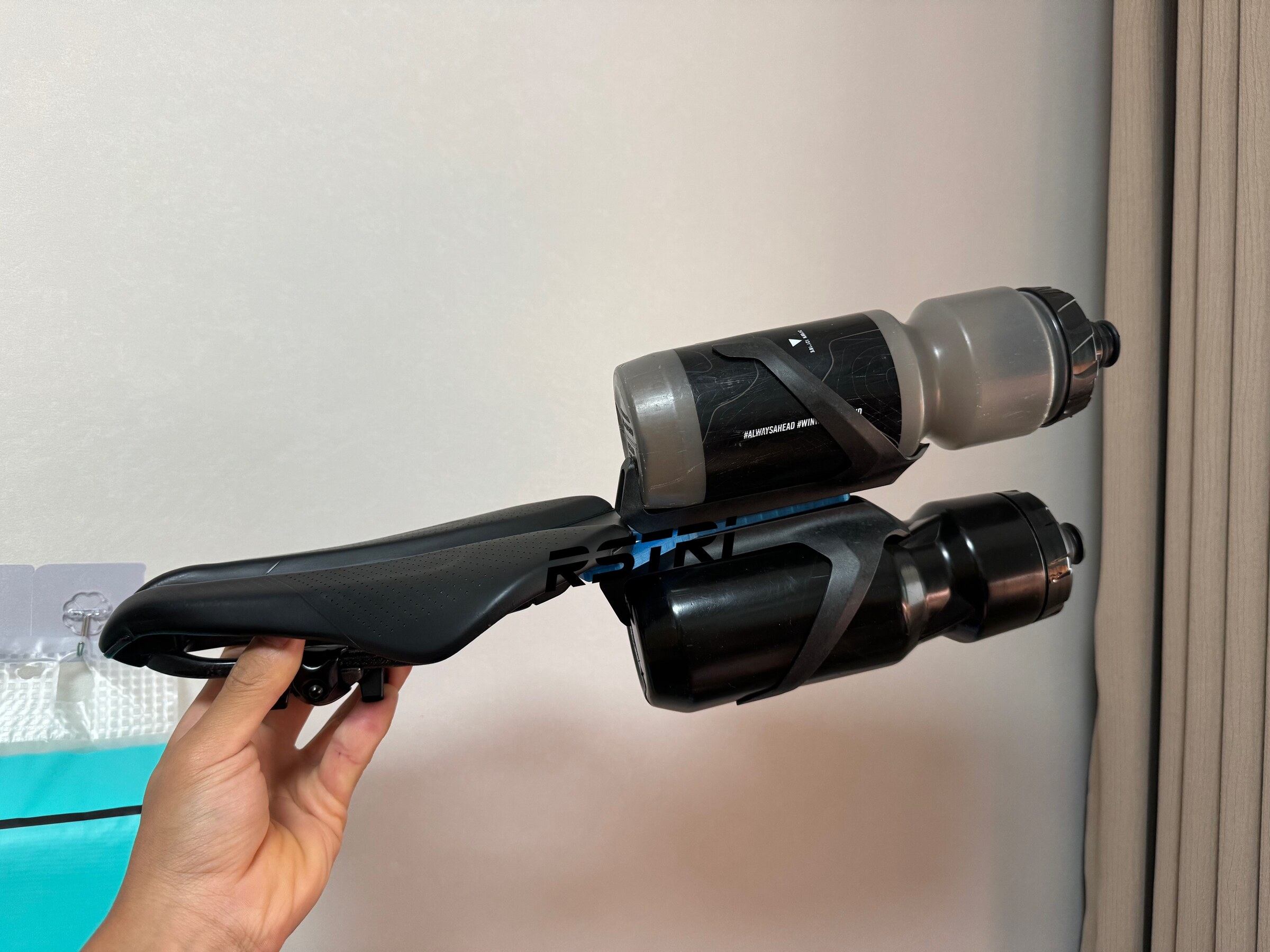
Behind the Saddle Hydration: Why Bottle Position Matters More Than You Think
A bottle behind the saddle may sit in the rider’s wake, but height, angle and distance change the airflow it meets. The relevant question is where the bottle sits relative to this...
Learn More →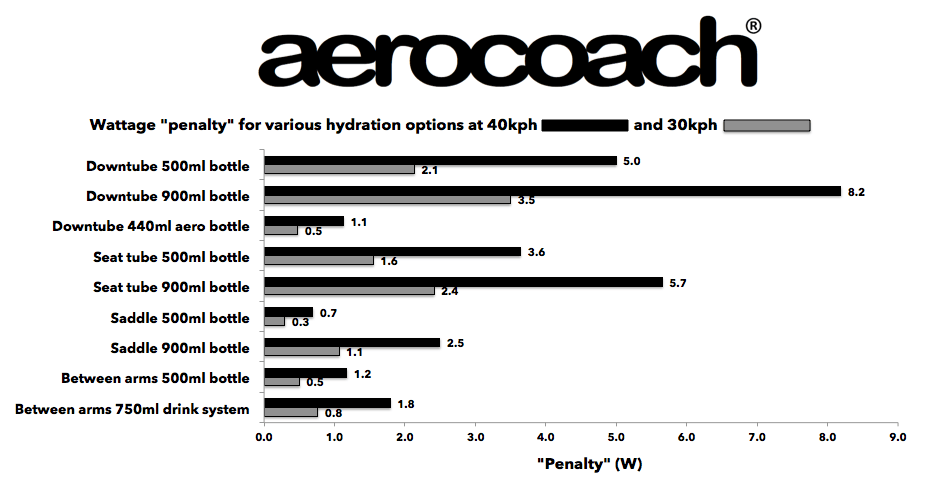
Where Should You Carry Your Water? Aero Testing of BTA, Frame and BTS Bottle Positions
AeroCoach tested bottle locations on one rider and TT bike. The 500 ml round bottle ranged from +0.7 W behind the saddle to +5.0 W on the downtube at 40 km/h; the result is a guide...
Learn More → Featured
RSTRI LAB | Get Faster for Free: Triathlon Aero Position Guide
Using real race photos, we look at aerobar width, head-and-arm integration, flexibility, drop and reach—and why the fastest aero position is the one you can safely hold for hours.
Learn More →